
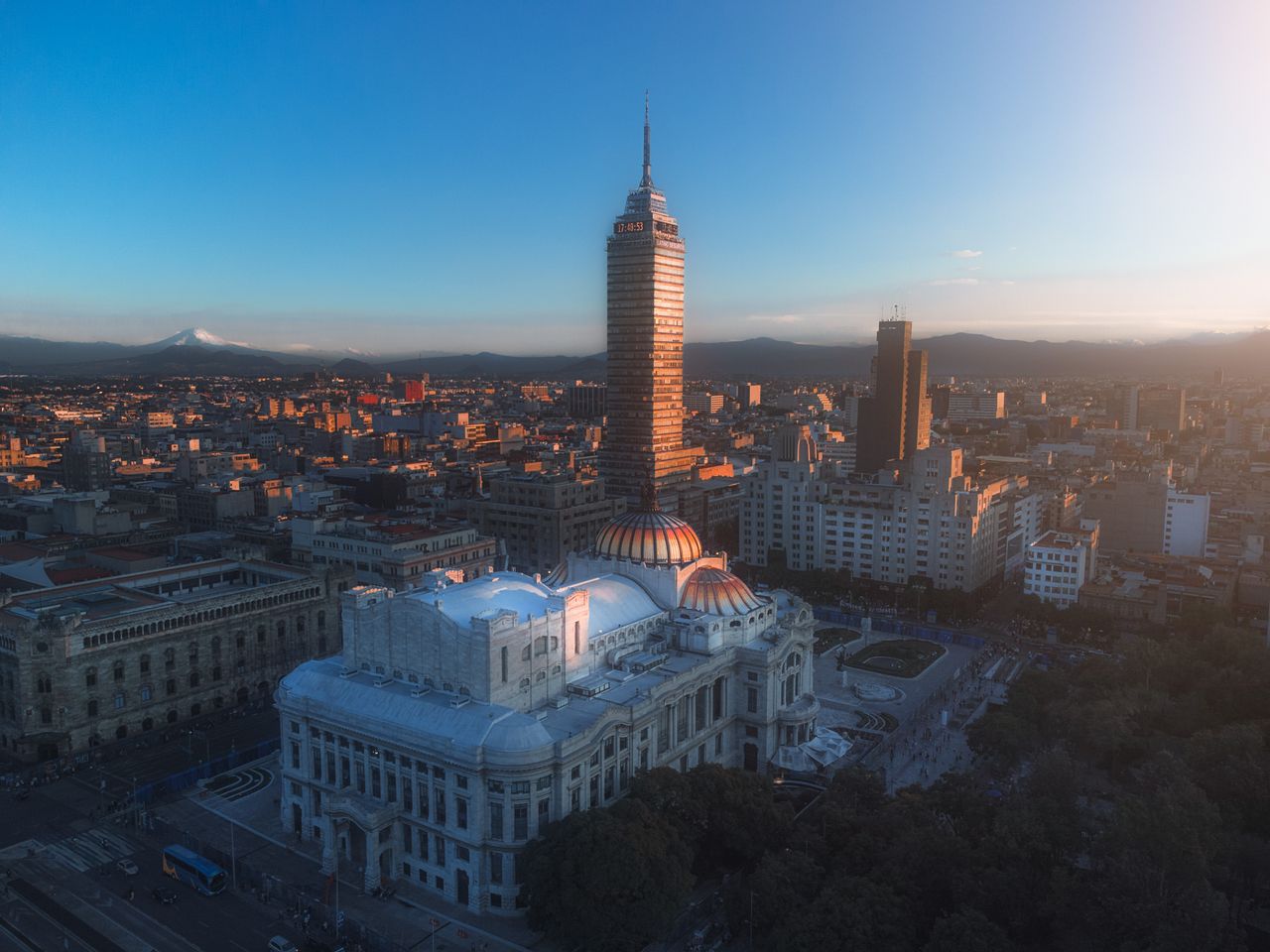
There is a particular Mexico City aesthetic that cannot be reduced to style alone. It exists somewhere between polished restraint and theatrical abundance, where impeccable tailoring meets exuberant street life, where centuries-old stone façades cast shadows over contemporary glass towers. To understand Mexico City is to accept its contradictions—not as flaws, but as the very essence of its identity. Here, elegance rarely seeks perfection. Instead, it embraces complexity, memory, and the confidence to coexist with opposing ideas.
The Mexico City Aesthetic: A City That Refuses Simplicity
Every great metropolis develops its own visual language. Paris whispers refinement. Tokyo celebrates precision. New York thrives on relentless reinvention.
Mexico City speaks in contrasts.
Its beauty comes from friction rather than harmony. The city has never attempted to erase its historical layers in pursuit of uniformity. Instead, pre-Hispanic foundations, colonial grandeur, modernist optimism, and contemporary experimentation continue an ongoing conversation across neighborhoods, generations, and social realities.
Walking through the capital means constantly shifting between worlds. A discreet residential street suddenly opens into monumental architecture. An intimate café exists beside a building whose façade demands attention. Silence and noise alternate with surprising rhythm.
This is not accidental.
The city’s aesthetic identity has always been shaped by coexistence rather than exclusion.
Luxury, here, is not defined by isolation from everyday life. It is defined by proximity to it.
Polanco: Where Sophistication Learns Restraint
Among the many districts that compose the capital’s personality, Polanco offers perhaps its most refined interpretation of contemporary urban living.
Its elegance does not rely solely on international luxury boutiques or celebrated restaurants. Instead, it emerges from proportion, rhythm, and confidence.
Tree-lined avenues soften dense urbanity. Limestone façades stand beside minimalist residences without competing for attention. Boutique galleries, independent bookstores, carefully curated cafés, and discreet hospitality create an atmosphere that rewards observation instead of spectacle.
Unlike neighborhoods that constantly demand to be photographed, Polanco invites slower appreciation.
Architecture becomes less about individual landmarks and more about collective composition.
The result is an environment where daily rituals—walking, reading, drinking coffee, dining outdoors—feel intentionally elevated without becoming performative.
Luxury becomes almost invisible.
And perhaps that is the greatest sophistication of all.
Design That Ages Instead of Following Trends
One characteristic distinguishes the neighborhood from many contemporary luxury districts around the world.
Materials matter more than novelty.
Natural stone develops texture with time. Brass quietly acquires patina. Wood darkens. Concrete softens beneath changing light.
Rather than resisting aging, many of Polanco’s most compelling interiors embrace it.
There is confidence in permanence.
Between Minimalism and Maximalism
The visual identity of Mexico City has never belonged exclusively to either minimalism or exuberance.
Instead, it comfortably inhabits both.
One morning may begin inside a serene gallery where white walls frame contemporary Mexican abstraction with meditative restraint.
Hours later, the senses encounter colorful street markets overflowing with flowers, textiles, fruit, music, spices, and conversation.
Neither experience contradicts the other.
They complete each other.
This coexistence has influenced generations of Mexican architects, designers, photographers, chefs, and artists who understand that refinement does not require emptiness.
Nor does abundance require disorder.
The most memorable spaces across the city often balance disciplined geometry with emotional warmth.
That balance has become one of Mexico City’s defining visual signatures.
Coffee, Gastronomy, and the Art of Observing
Cities reveal themselves through their cafés almost as much as through their monuments.
Mexico City has cultivated a coffee culture that values atmosphere as deeply as flavor.
Natural light entering through tall windows. Carefully selected ceramics. Quiet conversations between architects, writers, designers, entrepreneurs, and travelers.
The experience feels intentionally unhurried.
Coffee becomes less about consumption and more about observation.
The same philosophy extends into the city’s contemporary gastronomy.
Rather than relying solely on theatrical presentations, many chefs focus on narrative.
A single dish might reinterpret ancestral ingredients through contemporary techniques while preserving cultural memory.
Dining becomes an act of reflection rather than performance.
The aesthetic extends beyond the plate.
Lighting, acoustics, furniture, tableware, and spatial composition all participate in telling the story.
Architecture as Emotional Geography
Perhaps nowhere does the city’s contradiction become more beautiful than in its architecture.
Mexico City’s built environment is remarkably resistant to simplification.
Modernist masterpieces coexist with Art Deco residences.
Colonial courtyards hide behind modest entrances.
Brutalist structures absorb afternoon sunlight with surprising elegance.
Contemporary buildings increasingly seek dialogue rather than domination.
The city rewards those willing to look upward, slow their pace, and notice proportion.
Architecture here is rarely isolated.
It participates in daily life.
Trees partially conceal façades.
Street vendors animate plazas.
Rain transforms stone surfaces into mirrors.
Even the changing altitude affects perception, making light appear softer than expected despite the density of urban life.
The city continuously edits itself.
Every hour produces another composition.
Excess Without Apology
There are moments when Mexico City appears almost overwhelming.
Traffic expands endlessly.
Street sounds overlap.
Visual information arrives from every direction.
Billboards compete with murals.
Historic churches stand within view of contemporary skyscrapers.
Luxury hotels share neighborhoods with family businesses operating for generations.
Yet this apparent excess possesses an unexpected coherence.
The city never attempts to become quiet.
Instead, it teaches selective attention.
One learns to notice the details that matter.
A doorway.
A reflection.
An old jacaranda tree framing modern architecture.
An elegant coat crossing a chaotic intersection.
Beauty emerges not despite complexity but because of it.
That lesson extends beyond urbanism.
It becomes a philosophy.
Living the Contradiction
Perhaps the greatest misunderstanding about Mexico City is believing its identity can be summarized.
It cannot.
The city remains intellectually restless.
Every neighborhood proposes a different conversation, every building preserves a different memory.
Every season changes the quality of light.
Even those who return year after year discover another version of the capital.
This perpetual evolution explains why so many creatives continue to make Mexico City their home.
The city refuses fixed definitions.
Instead, it offers continuous reinterpretation.
For residents, visitors, artists, architects, photographers, and thoughtful observers alike, the experience becomes less about collecting landmarks and more about cultivating perception.
Conclusion: The Elegance of Complexity
The most enduring cities resist easy narratives.
Mexico City belongs among them.
Its elegance is neither sterile nor predictable. Its moments of excess never erase its moments of extraordinary calm. Instead, both realities exist simultaneously, enriching one another.
Perhaps this is the true Mexico City aesthetic.
Not a style.
Not a trend.
But a way of seeing.
It is an understanding that beauty often lives between opposing ideas, where history meets ambition, restraint meets exuberance, and architecture becomes an emotional language rather than a collection of buildings.
Those who embrace that contradiction rarely leave unchanged.
Leave a Reply