
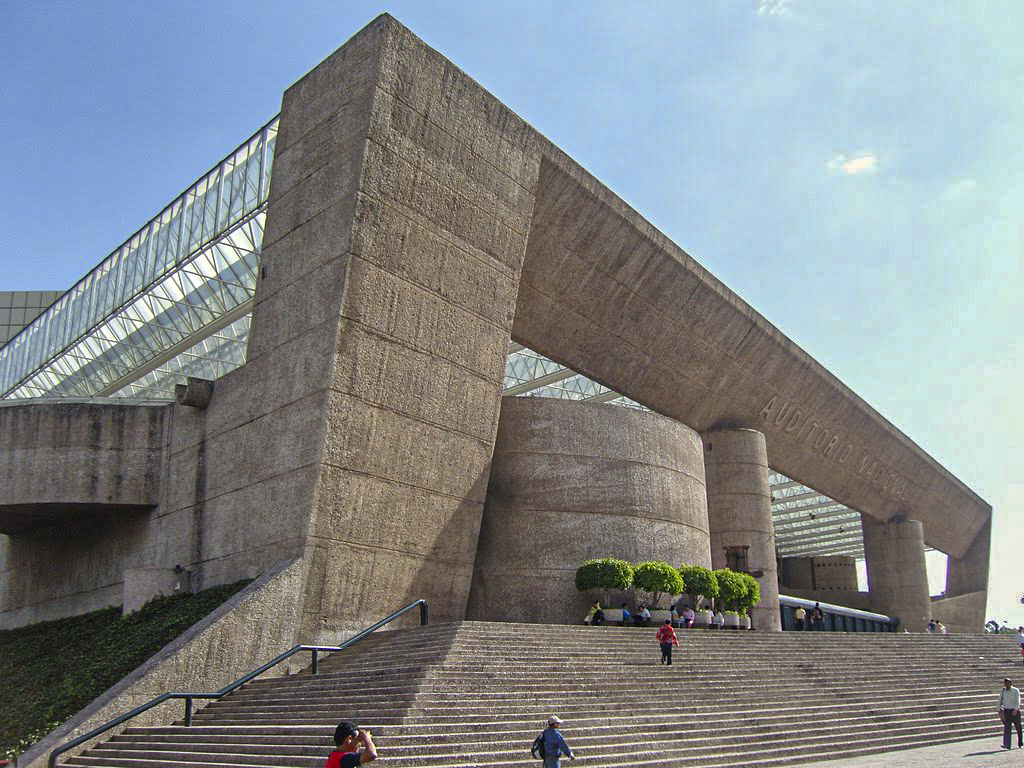
Concrete often carries an unfair reputation. It is seen as cold, severe, even hostile. Yet Mexico City brutalist architecture reveals something entirely different. Here, exposed concrete absorbs sunlight, frames jacaranda blossoms, and becomes a quiet canvas for everyday life. Rather than dominating the landscape, it invites reflection. It asks visitors to slow down, to notice proportion, shadow, and silence. Within a city celebrated for its color and exuberance, Brutalism offers an unexpected form of warmth—one built through honesty, permanence, and extraordinary design.
When Concrete Becomes Poetry
Architecture often tells us how a society imagines its future. During the middle decades of the twentieth century, Mexico embraced modernity with unusual confidence. New universities, museums, housing complexes, and cultural institutions emerged across the capital, combining international modernism with distinctly Mexican sensibilities.
The result was never a simple imitation of European Brutalism.
Instead, Mexican architects softened concrete with gardens, volcanic stone, natural light, native vegetation, and public art. Massive walls became stages for changing sunlight. Deep courtyards encouraged contemplation. Open plazas welcomed conversation rather than spectacle.
This approach transformed Brutalism into something emotional.
Rather than feeling defensive, the architecture feels generous.
Walking through these spaces today, visitors discover buildings that remain remarkably contemporary because they prioritize experience over decoration.
Brutalism Through a Mexican Lens
Unlike many cities where Brutalism arrived as an imported architectural language, Mexico City translated it into its own cultural vocabulary.
Concrete here exists alongside bougainvillea, lava rock, fountains, indigenous materials, and generous landscaping. Monumentality never entirely disconnects itself from humanity.
Architects understood that Mexico’s powerful sunlight could sculpt buildings throughout the day. Shadows become architectural elements themselves. Every hour produces a different atmosphere.
This relationship between structure and nature explains why many of these buildings continue to age gracefully.
Their surfaces record time rather than resisting it.
For visitors with an appreciation for design, this dialogue between permanence and change becomes one of the city’s most rewarding discoveries.
Polanco: Sophistication Framed by Modernism
Luxury in Polanco rarely announces itself loudly.
Its elegance lives in proportion, restraint, craftsmanship, and careful composition. Walking through its leafy avenues, visitors encounter residences and boutique buildings where modernist principles continue to shape contemporary lifestyles.
Glass reflects mature trees.
Natural stone softens geometric façades.
Concrete appears with remarkable confidence.
This architectural continuity creates a neighborhood where international fashion houses, independent galleries, refined cafés, and private residences exist within an environment that values design as part of daily life rather than an occasional luxury.
The rhythm feels intentional.
Morning begins with espresso on shaded terraces.
Afternoons unfold inside galleries where architecture receives as much attention as the exhibitions themselves.
Evening arrives through warm lighting that transforms minimalist interiors into intimate social spaces.
This balance between urban sophistication and human comfort defines much of Polanco’s enduring appeal.
The University That Became an Architectural Manifesto
Ciudad Universitaria
Few places express Mexico’s architectural ambition more convincingly than Ciudad Universitaria, the campus of the Universidad Nacional Autónoma de México (UNAM).
Here, monumental concrete structures emerge directly from ancient volcanic terrain. Architecture, landscape, engineering, and public art become inseparable.
Perhaps its greatest achievement lies in refusing to isolate knowledge from public life.
Students, researchers, artists, and visitors all share the same plazas, gardens, libraries, and cultural venues.
The experience is remarkably democratic.
Walking through the campus reveals murals integrated into architecture rather than attached afterward. Lava fields become outdoor rooms. Open courtyards encourage conversation beneath expansive skies.
The campus remains one of the world’s finest demonstrations of how modern architecture can respect both local geography and cultural identity.
Internal link opportunity: Architectural Icons of Mexico City
Museums Where Concrete Holds Silence
Brutalist architecture often reaches its highest expression through museums.
The city understands that art requires not only walls but atmosphere.
Buildings become instruments that shape perception before visitors encounter a single artwork.
Natural light filters carefully through concrete volumes.
Echoes become softer.
Attention naturally slows.
Institutions such as the Museo Tamayo Arte Contemporáneo demonstrate how architecture can disappear while simultaneously becoming unforgettable. Nearby, spaces devoted to contemporary art continue this dialogue between material honesty and cultural imagination.
The experience extends beyond exhibitions.
One notices textures beneath fingertips, filtered daylight across polished floors, and quiet transitions between interior and landscape.
The architecture becomes part of the collection.
Internal link opportunity: Museums That Transform a Visit into a Conversation
Coffee, Design, and the Geometry of Everyday Life
Brutalist beauty is not confined to monumental institutions.
It also appears in the city’s evolving café culture.
Many independent coffee houses now occupy restored modernist buildings where exposed concrete, handcrafted wood, and natural textiles create interiors of understated elegance.
Morning rituals become architectural experiences.
The sound of espresso machines mixes with soft conversation.
Sunlight traces clean lines across unfinished walls.
Ceramics feel heavier in the hand.
Nothing appears excessive.
This quiet aesthetic reflects a broader movement within Mexico City’s creative community. Designers, architects, photographers, and writers increasingly favor spaces where authenticity replaces ornament.
Coffee becomes less about speed than presence.
Even a brief pause acquires a contemplative quality.
Internal link opportunity: Polanco: Where Design Speaks in a Low Voice
A City That Finds Warmth Inside Monumentality
At first glance, Brutalism appears defined by weight.
Yet Mexico City reveals something lighter.
The city’s architects understood that emotion could emerge from restraint rather than decoration. Concrete gains softness through gardens. Monumentality becomes intimate through scale. Silence encourages attention instead of distance.
Perhaps this explains why these buildings continue to resonate with new generations.
They resist fashion, they reward patience. They ask visitors not simply to observe architecture but to inhabit it.
For those willing to slow their pace, Mexico City brutalist architecture becomes more than an aesthetic movement. It becomes a way of understanding the capital itself—a city where history embraces modernity, where intellect coexists with emotion, and where beauty often reveals itself through the simplest materials.
Concrete, after all, is only the beginning.
Leave a Reply